Uncovering My Unknown Unknowns with Plausible Analytics
Today I dove deeper into analytics, migrated to a self-hosted Plausible instance, and realized my superpower is uncovering my own unknown unknowns. Plus, a small teaser about what I'm building next!
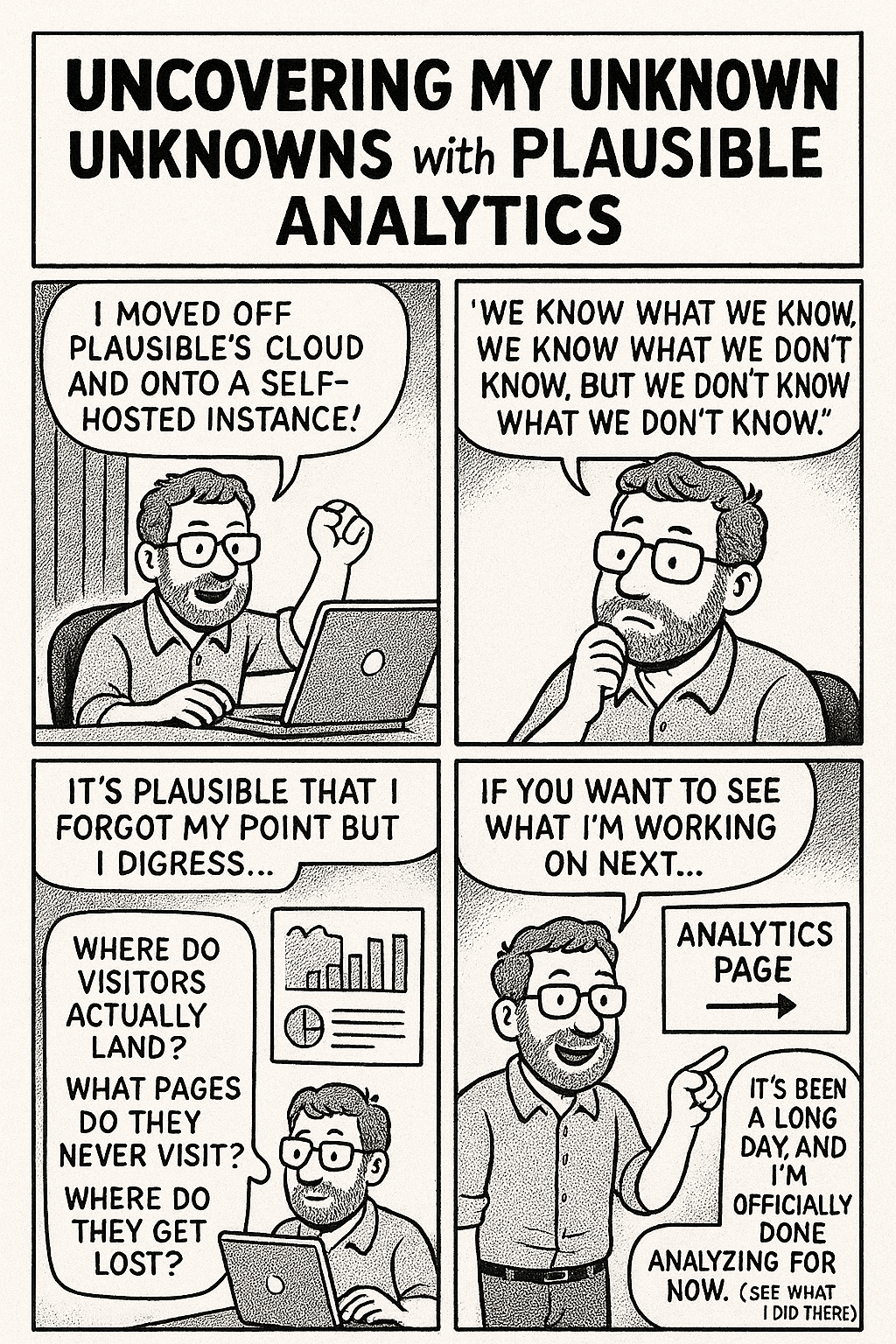
Uncovering My Unknown Unknowns with Plausible Analytics
Today was a big analytics day for me.
I took the leap and moved off Plausible’s cloud and onto a self-hosted instance — and honestly, I’m proud of that.
Not because there’s anything wrong with Plausible’s hosted offering (it’s great!), but because there’s something satisfying about taking back that control. It feels good to avoid the money grab and build something sustainable on my own infrastructure.
That Quote That’s Been Stuck in My Head
Somewhere in the dusty attic of my memory, there’s this quote I first heard years ago:
“We know what we know. We know what we don’t know. But we don’t know what we don’t know.”
I’m probably butchering it (and I’d rather not attribute it to the original speaker just in case I’ve turned it into nonsense), but I’ve thought about that statement for years.
It sounds kind of dumb when you first hear it — but it’s actually brilliant.
Because that is the superpower I’ve been cultivating: uncovering my unknown unknowns.
The more of them I reveal, the easier my problems are to solve.
Analytics as a Learning Tool
It’s plausible (pun very much intended) that I forgot my original point, but I digress…
Setting up analytics for my site wasn’t just about pageviews or bounce rates.
It was about revealing blind spots in my understanding.
- Where do visitors actually land?
- What pages do they never visit?
- Where do they get lost?
In the process of self-hosting Plausible, I uncovered a few unknown unknowns of my own — and by the time I converted them into knowns, I had already shipped a couple new features.
What’s Next?
If you want to see what I’m talking about, head over to my new Analytics Page and see if you can guess what I’m building next.
It’s been a long day, and I’m officially done analyzing for now.
(See what I did there?)
[^1]: Attribution: This post was written by Sean, with generative assistance from ChatGPT (GPT-5). The content and tone were based on Sean’s original prompt, with ChatGPT helping organize ideas, structure the sections, and polish for readability.